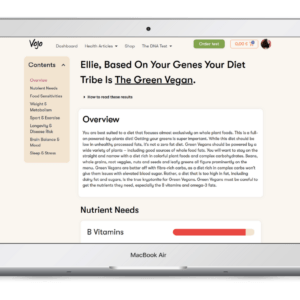


Interested in getting a DNA test, but want to know the process before you buy? You’re in the right place. How do DNA tests work, exactly?
Is it a blood test?
Do you have to get it again next year?
What does your DNA even tell you?
I’m Ellie Busby, founder of Vojo, and I’m here to answer all your questions. So, how do DNA tests work?
 Nope, not a drop of blood in sight. (You can get DNA from your blood, but it’s not necessary.)
But, aside from DNA testing, I recommend getting a regular blood test to check your health is on track.
Nope, not a drop of blood in sight. (You can get DNA from your blood, but it’s not necessary.)
But, aside from DNA testing, I recommend getting a regular blood test to check your health is on track.
 The best thing about DNA testing is that it’s just saliva. (So don’t leave your drool lying around on anyone’s pillow if you don’t want them to harvest your genetic data.)
Yup, even easier than a COVID test.
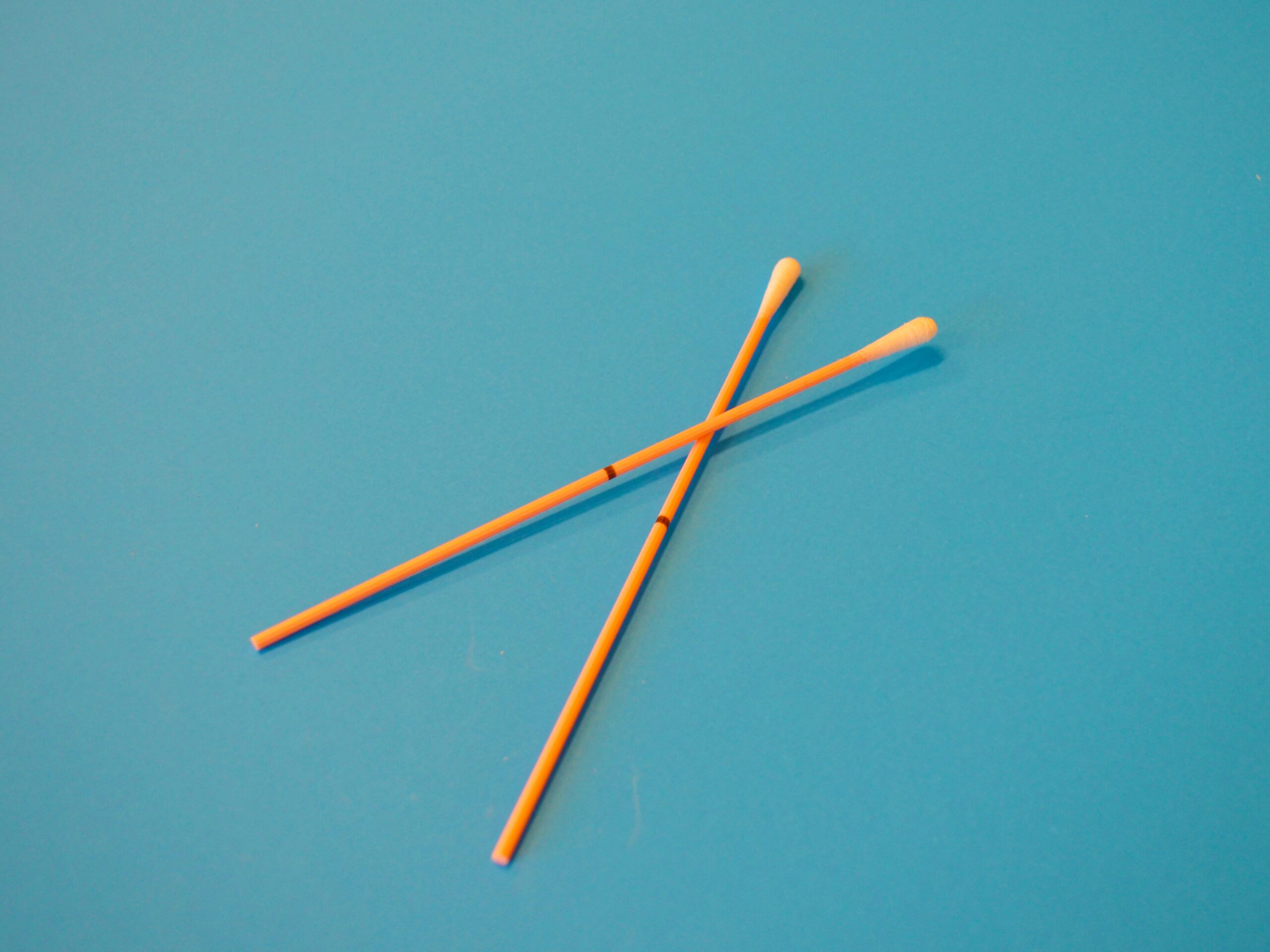
When you order your DNA test you’ll get a swab kit in the post. Some companies send tubes you spit in instead of a cheek swab.
We use cheek swabs because it’s 95% less plastic than a tube. All you do is rub it on the inside of your cheek for 30 seconds, stick it in the pouch provided and post it.
Download our instruction manual to find out exactly how to take your sample.
ACTION: Get the DNA test
The best thing about DNA testing is that it’s just saliva. (So don’t leave your drool lying around on anyone’s pillow if you don’t want them to harvest your genetic data.)
Yup, even easier than a COVID test.
When you order your DNA test you’ll get a swab kit in the post. Some companies send tubes you spit in instead of a cheek swab.
We use cheek swabs because it’s 95% less plastic than a tube. All you do is rub it on the inside of your cheek for 30 seconds, stick it in the pouch provided and post it.
Download our instruction manual to find out exactly how to take your sample.
ACTION: Get the DNA test
 There are a few weeks of waiting between posting off your sample and getting your results. What’s happening to your sample during that time?
DNA testing companies usually partner with a third-party lab to do the lab work like extracting your DNA from your saliva and analyzing it to get your DNA data.
They analyze samples in batches, so there’s a few days delay while waiting for enough samples to arrive.
Some companies use labs outside the UK or the EU, so posting takes longer. We use a lab in the UK.
ACTION: Find out more about our lab and how they handle your data here.
There are a few weeks of waiting between posting off your sample and getting your results. What’s happening to your sample during that time?
DNA testing companies usually partner with a third-party lab to do the lab work like extracting your DNA from your saliva and analyzing it to get your DNA data.
They analyze samples in batches, so there’s a few days delay while waiting for enough samples to arrive.
Some companies use labs outside the UK or the EU, so posting takes longer. We use a lab in the UK.
ACTION: Find out more about our lab and how they handle your data here.
 There are a few ways to analyze DNA.
Most DNA testing companies use genotyping.
There are a few ways to analyze DNA.
Most DNA testing companies use genotyping.
 If you agree to take part in scientific research, your sample might go into a biobank. This is when your saliva sample is put into storage and used for future analysis or scientific research.
At Vojo your saliva sample is destroyed after analysis, so there’s no risk of your genes floating around anywhere for someone to nick.
If you agree to take part in scientific research, your sample might go into a biobank. This is when your saliva sample is put into storage and used for future analysis or scientific research.
At Vojo your saliva sample is destroyed after analysis, so there’s no risk of your genes floating around anywhere for someone to nick.
 Yes! The study of the relationship between your genes and diet in science is called nutrigenomics. In fact, there are whole university departments dedicated to studying nutrigenomics.
At Vojo every part of your results and personalised diet plan are built off thousands of peer-reviewed research papers. We update our analysis algorithm a couple of times a year so your results are always up to date.
Yes! The study of the relationship between your genes and diet in science is called nutrigenomics. In fact, there are whole university departments dedicated to studying nutrigenomics.
At Vojo every part of your results and personalised diet plan are built off thousands of peer-reviewed research papers. We update our analysis algorithm a couple of times a year so your results are always up to date.
How Do DNA Tests Work? The Top 7 Questions About DNA Testing
1. Is it a blood test?
Nope, not a drop of blood in sight. (You can get DNA from your blood, but it’s not necessary.)
But, aside from DNA testing, I recommend getting a regular blood test to check your health is on track.
2. Are DNA tests invasive or do they hurt?
The best thing about DNA testing is that it’s just saliva. (So don’t leave your drool lying around on anyone’s pillow if you don’t want them to harvest your genetic data.)
Yup, even easier than a COVID test.
When you order your DNA test you’ll get a swab kit in the post. Some companies send tubes you spit in instead of a cheek swab.
We use cheek swabs because it’s 95% less plastic than a tube. All you do is rub it on the inside of your cheek for 30 seconds, stick it in the pouch provided and post it.
Download our instruction manual to find out exactly how to take your sample.
ACTION: Get the DNA test
3. Where does my sample go?
There are a few weeks of waiting between posting off your sample and getting your results. What’s happening to your sample during that time?
DNA testing companies usually partner with a third-party lab to do the lab work like extracting your DNA from your saliva and analyzing it to get your DNA data.
They analyze samples in batches, so there’s a few days delay while waiting for enough samples to arrive.
Some companies use labs outside the UK or the EU, so posting takes longer. We use a lab in the UK.
ACTION: Find out more about our lab and how they handle your data here.
4. How is my sample analyzed?
There are a few ways to analyze DNA.
Most DNA testing companies use genotyping.
OK, what’s genotyping?
Genotyping looks at common changes in your DNA - called single-nucleotide polymorphisms. We call them SNPs for short - pronounced ‘snips’. (It’s less accurate, but some people call them ‘variations’ or ‘mutations’.) After your DNA has been extracted, the lab compares your genes to a chip with 100,000s of known SNPs to see which ones you have. They create a long list of all the SNPs they found. They send us all this data, and we analyze this again to find the SNPs related to health and nutrition to build your personalised diet and lifestyle report. Find out about all the health and nutrition reports you get here. For important terms and definitions, go to the bottom of this article.5. What happens to my saliva after it’s been analyzed?
If you agree to take part in scientific research, your sample might go into a biobank. This is when your saliva sample is put into storage and used for future analysis or scientific research.
At Vojo your saliva sample is destroyed after analysis, so there’s no risk of your genes floating around anywhere for someone to nick.
6. Is DNA testing backed by real science? Is it accurate?
Yes! The study of the relationship between your genes and diet in science is called nutrigenomics. In fact, there are whole university departments dedicated to studying nutrigenomics.
At Vojo every part of your results and personalised diet plan are built off thousands of peer-reviewed research papers. We update our analysis algorithm a couple of times a year so your results are always up to date.
7. How often will I need to take a DNA test?
Once! Your DNA never changes, so you only need to take your Vojo DNA test once to get your personalised plant-based plan for life.The bottom line
So, should you take a DNA test? If you want to start working with your body rather than against it, get in shape in the best way for you, and make sure you’re getting all the nutrients you need to live a long healthy life - yes! For less than 100 bucks, you can have crucial information about how your body works which could change the way you live, and is relevant for the rest of your life. We focus on sustainable, plant-based advice at Vojo - you don’t have to be vegan to get the DNA test from us. Ready? Get your DNA test here.Important Terms
DNA
Your body contains 50 trillion tiny cells, and almost every one of them contains the complete set of instructions for making you. These instructions are encoded in your DNA. DNA is a long, ladder-shaped molecule.Allele
Each rung on your DNA ladder is made up of a pair of units called alleles. Your alleles are made from a ‘nucleotide’ or ‘base’ - a molecule that is designated by the four letters in the DNA alphabet - A, T, G and C. ‘A’ always pairs with ‘T’ and ‘G’ always pairs with ‘C’ (that’s just the way it is).Chromosome
Your long strands of DNA are organised into chromosomes so they can fit inside your cells. Humans have 23 pairs of chromosomes.Gene
Genes are short segments of DNA. If you imagine your DNA as a cookbook, then your genes are the recipes. Each gene tells your body to make a specific enzyme or protein. Written in the DNA alphabet - A, T, C, and G - the recipes tell your cells how to function and what traits to express.Genotype
The two alleles inherited at a given SNP position, one inherited from your father, one inherited from your mother.Haplotype
A specific combination of SNPs all occurring on the same chromosome (i.e. all occurring on the chromosome inherited from your Dad, or, inherited from your Mum).Phenotype
The traits or conditions you can see, measure, or diagnose, like eye color or high cholesterol.Polymorphism
A sequence difference at a particular position. The alternative forms are called alleles.rs number
The rs number is the official code name given by dbSNP, the biggest database of SNPs by the National Institutes of Health.Single Nucleotide Polymorphism (SNP; pronounced snip)
A posh phrase for a common genetic variation. Your Vojo results looks at around 200 SNPs in total.Wild-type
Wild-type is the most common SNP in the population. Wildtype doesn’t automatically mean it’s the ‘good’ version - it’s just the most common.


Why Do a Genetic Test for Health Reasons?
Can a genetic test help your health? Is it really useful for health issues, and is it going to get you towards your health goals? Read on to find out.

Do You Ship To Countries Outside Europe?
No, we don’t currently send test kits outside of Europe. If you live in the US, Canada, Australia, New Zealand,

Can a DNA Test Help You Lose Weight? 7 Surprising DNA Insights
A DNA test can tell you lots of things about your health. But can a DNA test help you with